A saddle cabinet should hold your riding equipment without making everyday barn chores more difficult. Before buying one, check how many saddles you need to store, what other equipment belongs inside, and whether the cabinet will fit comfortably in your tack room.
The right choice depends on more than storage capacity. Door clearance, rack placement, shelving, and the number of people using the space all affect how convenient a cabinet will be.
This checklist will help you compare those details before placing an order, whether you're outfitting a personal barn or choosing storage for several riders.
1. Count the Saddles That Need Dedicated Storage
Start with the saddles you use regularly rather than estimating how much storage you might need.
Count your English and Western saddles separately, especially if you own both types. Consider their overall dimensions and how easily you'll be able to lift each saddle onto its rack.
Then ask yourself:
- How many saddles need permanent storage?
- Will more than one rider use the cabinet?
- Do you need space for an additional saddle later?
- Would separate storage positions make equipment easier to access?
A cabinet with multiple racks may seem like the obvious choice, but rack count alone doesn't tell you whether your equipment will fit comfortably.
Check the cabinet's interior arrangement and ask about available space around each rack, particularly if you own a larger Western saddle.
For a smaller setup, our single saddle cabinet with shelf includes one saddle rack, an interior shelf, and a bridle hook. It's a useful starting point when comparing storage requirements for one horse.
2. Choose a Layout That Matches Your Equipment
Once you know how many saddles need storage, think about the smaller items you want nearby.
Some riders prefer keeping bridles, halters, and tack-care supplies in the same cabinet. Others need most of the interior space for saddles.
The difference matters when choosing between rack-heavy and combination layouts.
For example, our double-door cabinet with three saddle racks offers dedicated positions for three saddles, while the double-door cabinet with racks and shelves provides two saddle racks on one side and shelving on the other.
Neither arrangement is automatically better. The right choice depends on what you actually need to store.
Before ordering, make a simple equipment list and compare it with the fittings shown in each product description. Don't assume every cabinet includes the same number of shelves, hooks, or racks.
3. Measure the Cabinet Location and Working Space
A cabinet can fit against a wall and still be awkward to use.
Measure the available width, depth, and height, then look at what happens when the doors are open.
Check for nearby doorways, windows, electrical fixtures, sloped ceilings, and other furniture. You should also consider whether the cabinet will interfere with the normal route through the tack room.
Check the Space in Front of the Cabinet
Imagine removing your largest saddle while someone else walks through the room.
Will you have enough space to lift the saddle, turn around, and carry it away without hitting a door or nearby equipment?
If you're comparing several models, mark their approximate footprints on the floor with painter's tape. This gives you a better sense of how much room each cabinet occupies.
Remember that the dimensions listed for a cabinet don't necessarily include the additional space needed to open its doors and handle equipment.
Consider an Unused Corner
A corner location may be useful when straight wall space is limited.
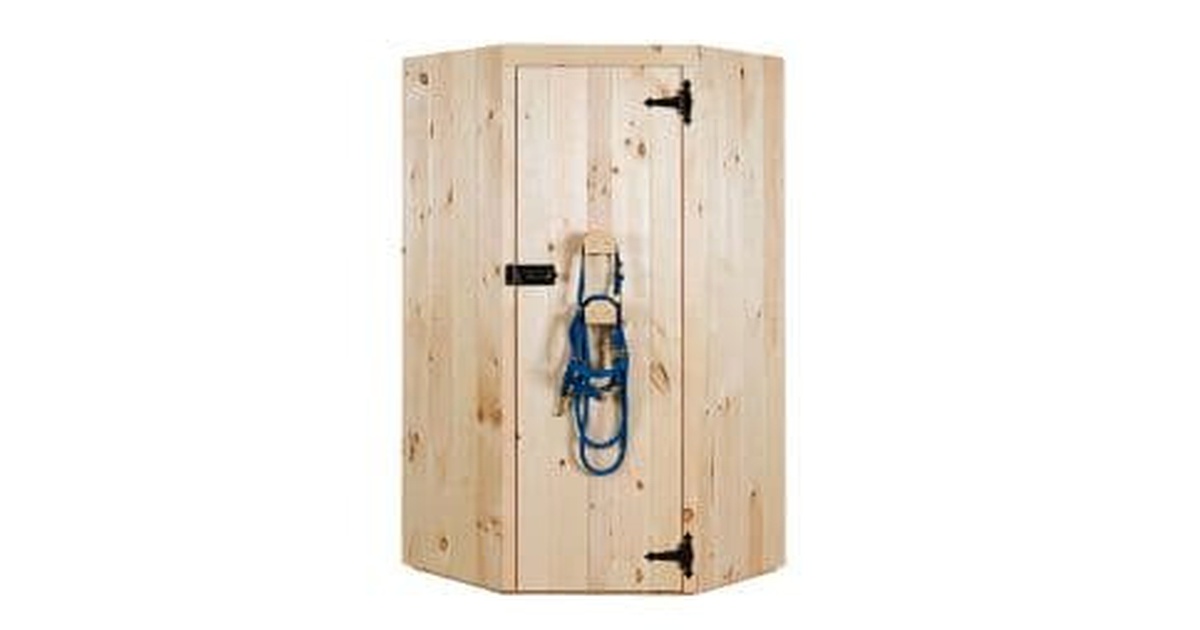
Our corner saddle cabinet includes two saddle racks, small interior shelves, and bridle hooks.
Before selecting a corner model, confirm that the cabinet's shape and door arrangement work with the surrounding walls and furniture.
4. Think About How Riders Access Equipment
A tack room used by one person has different requirements from a space shared by several riders.
If two people prepare their horses at the same time, consider whether they can reach their equipment without getting in each other's way.
When comparing saddle cabinets, pay attention to door placement and how the interior racks and shelves are arranged.
For shared use, consider these questions:
- Can one rider retrieve a bridle while another removes a saddle?
- Are frequently used items accessible without moving other equipment?
- Would separate cabinets be more practical than one larger unit?
- Can shorter or younger riders comfortably reach the storage assigned to them?
A larger cabinet may offer more capacity, but two smaller units in different locations could work better when riders regularly need access at the same time.
Think about the busiest part of your normal riding schedule rather than how the room looks when nobody is using it.
5. Decide Which Items Need Separate Storage
Not everything in a tack room needs to go inside the saddle cabinet.
If the interior is already occupied by saddles and bridles, adding grooming supplies, spare blankets, and miscellaneous equipment may make everyday access inconvenient.
Decide which items should stay close to the saddles and which could be stored elsewhere.
Our tack storage cabinets and boxes offer additional options for supplies that don't require dedicated saddle racks.
If you're also reviewing how to care for stored equipment, our existing article, The Importance of Proper Horse Tack Storage, covers tack-care and storage considerations.
Keeping those decisions separate helps you choose a cabinet based on its intended job rather than trying to fit every barn supply into one piece of furniture.
6. Review Hardware, Finish, and Customization Options
Before choosing a model, read its individual specifications rather than relying on a general product photo.
At Cupolas Direct, our Amish-made wooden cabinets are offered in several configurations. The product listings identify standard fittings and available upgrades.
Check the following details before ordering:
- Door hardware: Confirm the included latch and whether an optional lockable hasp is appropriate for your needs.
- Interior fittings: Review the standard racks, shelves, and hooks.
- Additional storage: Ask whether extra fittings can be accommodated in your preferred model.
- Finish: Our pine cabinets are supplied unfinished, and we recommend coating, staining, or painting the wood for longevity.
- Mobility: If you want casters, confirm their suitability for the cabinet you select.
Customization is available, but the practical options depend on the model and requested changes.
It's better to clarify these details before ordering than to assume a feature shown on another cabinet will be included.
7. Check Delivery and Placement Requirements
Your final decision should include how the cabinet will reach its intended location.
Measure the route from the unloading point to the tack room. Include gates, building entrances, narrow hallways, and tight turns.
Our larger barn furniture pieces generally ship by motor freight, while some smaller pieces may qualify for ground shipping.
Motor freight delivery requires someone to be present to inspect and accept the shipment and assist with unloading. Liftgate service may be needed when suitable unloading equipment isn't available.
Review our shipping and delivery information before ordering, especially if your barn has limited vehicle access.
Also check the availability stated on the specific product page. Build and shipping estimates can vary by model, so don't rely on a general timeline when planning for a particular delivery date.
Review Your Measurements Before Ordering
Before making your final selection, have your saddle count, equipment list, cabinet location measurements, and preferred interior arrangement ready.
At Cupolas Direct, we offer handcrafted Amish-made barn furniture in single-door, double-door, corner, and combination configurations.
If you're unsure which layout fits your routine, contact our team with your tack-room dimensions, photos of the intended location, and a description of the equipment you need to store.
Call us at (717) 808-5711. We can help you compare available configurations and discuss suitable customization options before you place your order.